


Introduction
If you are searching for Osnovno Uciliste, you may want to understand its meaning, structure, and role in the education system. Osnovno Uciliste generally refers to primary or elementary education and is associated with several Balkan and Southeastern European education systems. Depending on the country, the structure can cover eight or nine years of compulsory schooling and usually combines foundational primary learning with lower-secondary education.
In this Osnovno Uciliste guide, JournalTodayz.com explains what the term means, how the school system is organized, what students typically study, and how it connects to secondary education. We also explore common age groups, grade levels, curriculum areas, and the transition from primary education to future academic pathways, helping parents, students, and curious readers understand this educational term clearly.
Understanding this system proves essential for parents, educators, researchers, and anyone navigating international education pathways. Accordingly, this article provides an in-depth exploration of its meaning, structure, curriculum, significance, and challenges in the contemporary educational landscape.
What Does Osnovno Uciliste Mean?
Definition and Terminology
Osnovno uciliste refers to compulsory primary education in several countries including North Macedonia, Serbia, Croatia, and other nations formerly part of Yugoslavia. The system combines traditional primary and lower-secondary education into a unified nine-year structure. Specifically, students progress through nine consecutive grades, beginning at approximately age six and completing around age fifteen.
This unified approach differs significantly from many Western education models that separate primary and secondary schools. Because of this comprehensive design, osnovno uciliste serves as the entire foundational educational stage rather than just elementary schooling alone.
Etymology and Linguistic Context
The linguistic breakdown reveals much about the system’s educational philosophy. Osnovno, as an adjective, carries conceptual weight similar to foundational or basic in English. This is intentional. The Balkan education systems deliberately emphasize that these nine years establish the bedrock upon which all future learning depends.
Uciliste, though sometimes written as učilište with diacritical marks, derives from the same root as uciti, meaning to teach or learn. Therefore, osnovno uciliste literally translates to a place where foundational learning occurs.
Geographic Distribution
Primarily, osnovno uciliste serves as the official terminology in North Macedonia, Serbia, Bosnia and Herzegovina, and Montenegro. Similarly, Croatia operates a comparable eight-year system with analogous objectives. Meanwhile, Slovenia maintains a nine-year compulsory education model with slightly different organizational frameworks.
Historical Context
The osnovno uciliste system emerged from Yugoslavia’s commitment to universal education. During Yugoslavia’s existence from 1945 to 1992, the Socialist government established education as a fundamental right and state responsibility. This legacy persists today. Accordingly, all successor nations maintain similar educational frameworks emphasizing equal access and standardization across regions.
Age, Duration, and Grade Structure
When Does Osnovno Uciliste Begin?
Students typically enter osnovno uciliste between ages six and seven. This timing aligns with similar primary education enrollment across Europe. Generally speaking, formal written permission from parents becomes necessary before a child starts the first grade.
The enrollment process itself involves straightforward documentation. Parents submit birth certificates, medical records, vaccination proof, and residency information to their local school or municipal education office. Additionally, families relocating from other countries may require official recognition of previous schooling.
Duration and Timeline
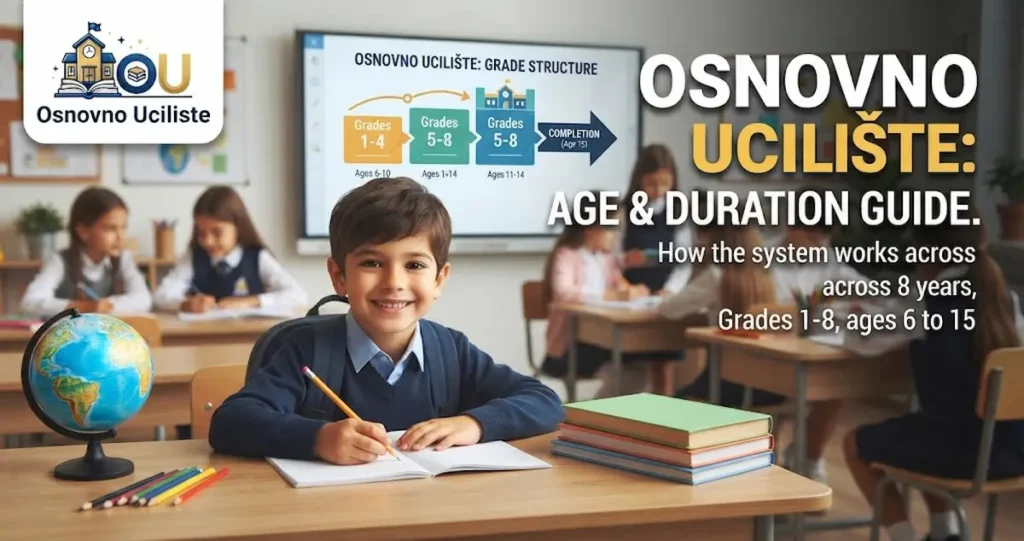
The complete osnovno uciliste cycle spans nine consecutive years. Consequently, students who begin at age six typically complete the program around age fifteen. This unbroken structure, however, offers pedagogical advantages that separate primary and secondary schools often lack.
The nine-year span divides into three distinct phases, each lasting three years. This organization aligns educational progression with child development stages. As a result, curriculum, teaching methods, and social expectations shift gradually rather than abruptly.
Grade Organization and Progression
| Phase | Grades | Age Range | Focus | Key Characteristics |
| Phase I | 1-3 | 6-9 years | Early Literacy | Basic skills, foundational concepts |
| Phase II | 4-6 | 9-12 years | Intermediate Learning | Subject specialization begins |
| Phase III | 7-9 | 12-15 years | Pre-Secondary | Advanced topics, exam preparation |
Advancement and Assessment
Students advance to the next grade annually upon successful completion of course requirements. Furthermore, retention occurs only in cases of serious academic deficiency. Each grade builds systematically upon previous knowledge, ensuring continuous skill development.
Assessment happens continuously throughout each school year. Teachers employ various methods including classroom participation, homework completion, written tests, and project-based evaluations. Subsequently, final examinations occur at the end of each academic year.
Curriculum and Core Subjects
Subject Areas and Academic Framework
The osnovno uciliste curriculum balances academic knowledge with personal development. Consequently, students engage with multiple disciplines designed to create well-rounded learners. The curriculum evolves as students progress through the three phases.
Early grades emphasize foundational literacy and numeracy. Therefore, students spend considerable time developing reading, writing, and mathematical skills. Meanwhile, they also explore basic science concepts and social studies.
Core Subjects Across All Grades
Students in osnovno uciliste study the following core subjects:
- Mother Language and Literature – encompasses reading, writing, comprehension, and cultural understanding
- Mathematics – covers arithmetic, algebra, geometry, and problem-solving skills
- Natural Sciences – includes biology, chemistry, physics, and environmental studies
- Social Studies – encompasses geography, history, civics, and cultural education
- Physical Education – develops motor skills, coordination, and health awareness
- Arts and Music – fosters creativity, aesthetic appreciation, and cultural expression
- Foreign Languages – typically English and German beginning in early grades
Curriculum Evolution Through Phases
As students progress through osnovo uciliste, the curriculum becomes increasingly specialized and challenging. In Phase I, lessons remain largely integrated and teacher-led. By Phase II, subject specialists begin teaching, and content deepens significantly.
Additionally, Phase III introduces more rigorous academic standards. Students prepare for secondary education entrance through intensive study. Examination preparation intensifies during grades eight and nine.
Modern Educational Additions
Contemporary osnovno uciliste programs increasingly incorporate digital literacy and technology skills. Specifically, computer classes teach programming basics, information technology, and digital citizenship. Furthermore, environmental education addresses sustainability and ecological responsibility.
Importantly, many schools now emphasize critical thinking development rather than rote memorization. Project-based learning, collaborative activities, and creative problem-solving receive greater emphasis than traditional methods.
Educational Goals and Student Development
Primary Objectives of Osnovno Uciliste
The fundamental purpose of osnovno uciliste extends beyond academic instruction. Rather, it aims to develop complete individuals prepared for secondary education and civic participation.
Specifically, osnovno uciliste pursues these core objectives:
- Establishing strong academic foundations in essential subjects
- Developing critical thinking and problem-solving capacities
- Fostering social responsibility and ethical behavior
- Building confidence, curiosity, and independence
- Creating culturally aware, compassionate citizens
- Preparing for transitions to secondary education
Intellectual Development
During osnovno uciliste years, children undergo significant cognitive development. Teachers actively encourage abstract thinking, logical reasoning, and analytical skills. As students mature through the nine years, their capacity for complex thought expands substantially.
Additionally, osnovno uciliste cultivates lifelong learning habits. Students learn to ask questions, seek information, and engage with new concepts. Consequently, these patterns established early continue benefiting them throughout their educational journeys.
Social and Emotional Development
Beyond academics, osnovno uciliste serves as a crucial socialization environment. Students learn cooperation, respect, and tolerance through daily interactions. Teachers act not only as educators but also as mentors and role models.
Through group projects, team sports, and extracurricular activities, students develop interpersonal skills. Therefore, they practice communication, conflict resolution, and collaborative problem-solving. These capabilities prove equally important as academic knowledge for future success.
Teacher Roles and Responsibilities
Teachers in osnovno uciliste bear substantial responsibility for student development. Beyond delivering curriculum, they observe individual growth, identify learning difficulties, and provide personalized support.
Furthermore, teachers serve as bridges between school and family. They communicate regularly with parents about student progress, concerns, and achievements. Consequently, this partnership strengthens the overall educational experience.
Osnovno Uciliste Across Different Countries
North Macedonia System
North Macedonia maintains the most standardized osnovno uciliste framework. The country’s nine-year primary education structure follows the organizational pattern established during the Yugoslav era. National curriculum standards ensure consistency across urban and rural areas.
Furthermore, the Macedonian system emphasizes equal educational opportunity. Accordingly, tuition remains free, and enrollment is mandatory. Students who complete osnovno uciliste in North Macedonia then progress to secondary education institutions offering academic or vocational pathways.
Serbian Implementation
Serbia operates a comparable nine-year compulsory education system with slight variations in curriculum emphasis. The Serbian Ministry of Education sets national standards, but individual schools maintain some implementation flexibility.
Additionally, Serbia has invested significantly in infrastructure improvements and teacher training. Consequently, recent years have witnessed enhanced educational quality across the country.
Croatian Model
Croatia maintains an eight-year osnovno uciliste model rather than nine years. The Croatian educational system shows stronger alignment with European Union standards following Croatia’s 2013 EU accession. This alignment has brought increased emphasis on digital competencies and competency-based learning frameworks.
Moreover, Croatian schools demonstrate higher PISA and TIMSS assessment scores compared to some neighboring countries. Therefore, the Croatian system serves as a model for educational excellence in the region.
Comparative Overview
| Country | Duration | Starting Age | Structure | Notable Features |
| North Macedonia | 9 years | 6-7 years | Unified 9-year | National standardization |
| Serbia | 9 years | 6-7 years | Unified 9-year | Infrastructure investment |
| Croatia | 8 years | 6-7 years | Unified 8-year | EU alignment |
| Bosnia & Herzegovina | 9 years | 6-7 years | Unified 9-year | Regional variations |
| Montenegro | 9 years | 6-7 years | Unified 9-year | Developing system |
The Nine-Year Structure Explained
Why Nine Years?
The nine-year osnovno uciliste structure reflects child developmental psychology and pedagogical research. Three consecutive three-year phases allow curriculum complexity to increase gradually. This progression aligns with how children’s cognitive abilities evolve naturally.
Furthermore, the continuous structure eliminates abrupt transitions between primary and secondary schooling. Consequently, students experience smoother educational progression.
Phase I: Grades 1-3 (Ages 6-9)
Phase I emphasizes foundational skill development. Teachers focus heavily on teaching students to read, write, and calculate. Additionally, early literacy and numeracy form the bedrock upon which all future learning depends.
During these initial years, classroom teachers typically instruct multiple subjects. This approach builds strong teacher-student relationships. Students benefit from consistent mentorship and personalized attention.
Concurrently, social development receives equal emphasis. Students learn classroom routines, respect for authority, and cooperation with peers. Play-based activities remain important components of daily instruction.
Phase II: Grades 4-6 (Ages 9-12)
Phase II marks the transition toward subject specialization. Furthermore, students now have subject specialists rather than single classroom teachers. This shift introduces students to disciplinary depth as different educators teach mathematics, sciences, languages, and other subjects.
Notably, student agency increases during Phase II. Teachers assign more homework, expect greater independence, and encourage critical thinking. Subsequently, academic rigor increases noticeably compared to earlier grades.
Additionally, extracurricular activities expand significantly. Students join clubs, participate in competitions, and engage in school projects. These experiences develop interests and talents beyond traditional academics.
Phase III: Grades 7-9 (Ages 12-15)
Phase III represents the pre-secondary culmination of osnovno uciliste. Academic content becomes increasingly challenging and specialized. Furthermore, students prepare seriously for secondary school entrance examinations.
During these final three years, career exploration begins. Teachers discuss educational pathways, vocational options, and further study possibilities. Students start considering their strengths, interests, and future directions.
Importantly, assessment becomes more formalized. Students face regular tests, examinations, and grading standards similar to secondary education. Consequently, they develop exam-taking skills and study habits necessary for advanced schooling.
Curriculum Standards and Learning Outcomes
National Standards and Assessment
Most osnovno uciliste systems implement national curriculum frameworks ensuring educational consistency. These frameworks define learning objectives, subject content, and assessment criteria.
Furthermore, standardized examinations occur at system transitions. Accordingly, students completing Phase III take examinations determining secondary school placement. These assessments measure achievement against national standards.
Learning Outcomes Framework
Students completing osnovno uciliste demonstrate competency across several domains:
- Academic Knowledge – mastery of core subject content including language, mathematics, and sciences
- Communication Skills – clear expression, listening comprehension, and multilingual abilities
- Critical Thinking – analytical reasoning, problem-solving, and logical analysis
- Collaboration – teamwork, perspective-taking, and interpersonal effectiveness
- Creativity – innovative thinking, artistic expression, and imaginative problem-solving
- Citizenship – understanding of rights, responsibilities, and social participation
- Digital Competence – technology literacy, information management, and digital ethics
Quality Assurance Mechanisms
Osnovno uciliste quality monitoring involves various mechanisms. Internal school assessments track student progress continuously. Meanwhile, external evaluations measure institutional performance against national standards.
Additionally, teacher qualifications and professional development ensure instructional quality. Consequently, all osnovno uciliste educators complete university-level training and ongoing professional education.
Practical Considerations for Families
Enrollment Process and Requirements
Families enrolling children in osnovno uciliste typically follow standardized procedures. Generally speaking, the local school in your residential area automatically becomes your designated institution.
However, some families apply for school choice options. Accordingly, enrollment happens during announced periods, typically before the academic year begins. Required documents usually include:
- Birth certificate or identity documentation
- Proof of residency
- Medical and vaccination records
- Previous school records (if applicable)
- Parental consent and contact information
Costs and Free Education
Public osnovno uciliste education remains completely free throughout the nine-year cycle. Importantly, neither tuition nor mandatory fees exist. This commitment to free education reflects the region’s educational philosophy emphasizing equal access.
However, families may voluntarily contribute to school activities, field trips, and extracurricular programs. Additionally, some families purchase school supplies, uniforms, or specialized equipment. Nevertheless, these costs remain optional and modest.
School Day Structure
Standard osnovno uciliste school days typically run from morning through early afternoon. Generally, classes begin between 7:30 and 8:30 AM and conclude by 2:00 or 3:00 PM. This timing accommodates multiple class shifts in some schools managing enrollment pressure.
A typical school day includes multiple class periods with brief breaks between subjects. Moreover, lunch facilities provide subsidized meals. Additionally, some schools offer after-school supervision for working families.
Parental Involvement Expectations
Schools actively encourage parental participation in child education. Furthermore, parent-teacher communication occurs regularly through scheduled conferences and informal contact.
Additionally, families support learning through homework supervision, reading at home, and discussing school experiences. Therefore, home learning extends classroom instruction significantly.
Challenges and Contemporary Issues
Infrastructure Limitations
Many osnovno uciliste schools, particularly in rural areas, face infrastructure challenges. Specifically, aging buildings, inadequate facilities, and technological gaps persist. Furthermore, capital investment in school renovation progresses slowly in several countries.
Subsequently, some students attend schools lacking modern laboratories, computer facilities, or sports equipment. Therefore, educational quality sometimes depends heavily on geographic location.
Teacher Shortages and Retention
Recruitment and retention of qualified teachers presents a significant challenge. Additionally, teacher salaries in several countries lag behind neighboring EU nations. Consequently, talented educators often emigrate seeking better compensation and working conditions.
Furthermore, teacher workload increases due to diverse student needs and administrative requirements. Therefore, burnout affects instructor well-being and educational quality.
Inclusion and Special Education
Mainstreaming students with disabilities into regular osnovno uciliste classrooms remains incomplete across the region. Additionally, specialized services, assistive technology, and staff training for inclusive education need expansion.
Furthermore, socioeconomic disparities affect educational outcomes. Students from disadvantaged backgrounds often lack resources supporting academic success.
Demographic Changes
Several countries experience declining birth rates and student populations. Consequently, some osnovno uciliste schools consolidate or close entirely. Furthermore, rural depopulation particularly affects educational access in smaller communities.
Future Directions and Modernization
Digital Transformation
Osnovno uciliste institutions increasingly incorporate digital technologies into instruction. Specifically, computer labs, interactive boards, and online learning platforms supplement traditional methods.
Furthermore, COVID-19 accelerated digital adoption. Consequently, schools developed remote learning capabilities and digital content. Additionally, students developed digital literacy skills through distance education experiences.
Curriculum Evolution
Contemporary osnovno uciliste systems gradually shift toward competency-based frameworks. Furthermore, project-based learning replaces some traditional methods. Additionally, interdisciplinary approaches integrate knowledge across subject boundaries.
Moreover, curricula increasingly address contemporary challenges including sustainability, digital citizenship, and mental health. Therefore, education becomes more responsive to real-world contexts.
Reforms and Policy Changes
Several countries propose significant osnovno uciliste reforms. Additionally, modernization initiatives address infrastructure, teacher development, and curriculum standards. Furthermore, international partnerships facilitate knowledge exchange and best practice adoption.
As a result, osnovno uciliste systems continue evolving to meet twenty-first century educational needs.
Osnovno Uciliste and Secondary Education Transition
Preparation for Secondary School
The final years of osnovno uciliste directly prepare students for secondary education. Specifically, Phase III curriculum aligns with secondary school entrance requirements.
Furthermore, students take entrance examinations determining secondary school placement. These assessments measure readiness for advanced academic work.
Secondary Education Pathways
Upon completing osnovno uciliste, students choose from various secondary education options. Generally, secondary schools offer either academic or vocational tracks.
Academic secondary schools prepare students for university-level study. Meanwhile, vocational schools provide practical training for specific careers.
Therefore, osnovno uciliste completion represents a crucial decision point affecting future educational and professional trajectories.
Frequently Asked Questions
What is osnovno uciliste?
Osnovno uciliste refers to the nine-year compulsory primary education system in Balkan and Central European countries, combining traditional primary and lower-secondary education.
What age do students start osnovno uciliste?
Students typically begin osnovno uciliste at approximately age six or seven, depending on their birthdate and country-specific regulations.
How long does osnovno uciliste last?
The complete osnovno uciliste program spans nine consecutive years, with students completing around age fifteen.
What subjects do students study?
Core subjects include language and literature, mathematics, natural sciences, social studies, physical education, arts and music, and foreign languages.
Is osnovno uciliste free?
Yes, public osnovno uciliste education is completely free throughout the nine-year cycle in all countries offering this system.
Which countries use osnovno uciliste?
North Macedonia, Serbia, Bosnia and Herzegovina, Montenegro, and Croatia maintain osnovno uciliste or comparable nine-year primary education systems.
What happens after osnovno uciliste?
Upon completion, students transition to secondary education, choosing between academic and vocational secondary schools based on entrance examination performance.
Is osnovno uciliste compulsory?
Yes, osnovno uciliste represents mandatory education, and enrollment is legally required for all children in participating countries.
How is osnovno uciliste organized?
The system divides into three phases lasting three years each, corresponding to child development stages and curriculum progression.
What are the admission requirements?
Enrollment requires birth certificates, residency proof, medical records, vaccination documentation, and parental consent.
Conclusion
Osnovno uciliste remains central to educational development across the Balkans and Central European regions. More significantly, this nine-year foundational education system shapes millions of young people’s intellectual, social, and emotional trajectories.
Understanding osnovno uciliste proves essential for parents, educators, policymakers, and anyone interested in international education systems. Furthermore, this comprehensive guide provides clarity regarding its meaning, structure, curriculum, and significance.
As global education evolves, osnovno uciliste institutions continue modernizing while maintaining commitment to universal, free, equitable education. Therefore, this foundational stage will remain crucial for preparing generations of engaged, capable citizens.
Looking forward, osnovno uciliste systems must address infrastructure challenges, teacher shortages, and inclusion gaps while embracing digital transformation and contemporary curriculum evolution. When these challenges receive appropriate attention and resources, osnovno uciliste can fulfill its mission providing exceptional foundational education preparing students for lasting academic and personal success.
